Harwell: Village for a thousand years

  • Harwell Book
    • Introduction
      • Contents
    • Beginnings
      • The Beginnings of Harwell
      • The Charters
    • Middle Ages
      • Harwell Church
      • The Medieval Manors
      • Cruck Buildings
    • Tudors
      • The Tudor period
      • Berkshire Farmers and their Homes
      • The Harwell Mug
      • Harwell: The Family Name
      • Trade Tokens
      • In the Civil War
    • Charities
      • John Loder
      • Christopher Elderfield
      • Poor’s Orchard
      • William Wells
      • J. King
      • Frances Geering
      • Matthew Eaton
      • Robert Loder
      • Bag(g)’s Tree
      • An Old Harwell Recipe
    • 19th C
      • Enclosures
      • The Great Fire of Harwell
      • Fire at Didcot Station
      • Harwell and the Early Posts
    • People
      • The Manor of Bishop’s Harwell, or Lower Manor, after the Middle Ages.
      • Bob Lay, Bob Lay, Bob Lay
      • The Bosley Family
      • John Lay of Prince’s Manor 1815 – 1888
      • From a book sold for the Blewbury Village Organ Fund in 1874.
      • Thomas James Pryor
      • The Day Family
      • The Hitchman Family
      • Other Old Harwell Families
      • Pillar House, Harwell
      • A Country Doctor (Dr Richard Rice)
      • Kelly’s Directory reports on the Harwell of 1891
      • The School
      • A Pictorial Miscellany
    • 20th C
      • Stanley Day
        • The Turn of the Century
        • A Visit to Harwell
      • Tape Recordings
        • A Houseboy at Harwell
        • Eliza Hutchings
        • Harwell Bakeries
        • The Eggs
        • Old Neighbours
        • Fire at King’s Farm (c.1908)
        • Will It Light?
        • Miss Irene Clarke’s memories.
      • Poem by H.S. Baker
    • WWII
      • Guinea Pig Club
      • Eric Greenwood
      • Harwell in Wartime
      • School Life in Wartime
      • The Harwell Players
    • 1945 -1985
      • The Atomic Energy Research Establishment.
      • Harwell Parish Council
      • Water and Sewage
      • Nursing Service
      • School Life after the War
      • The Winterbrook Youth Club
      • The Public Houses
      • The Whit Monday Feast
      • Wild Flowers of Harwell
      • The Bee Orchid
      • Village Footpaths
      • St Matthew’s Church Today
      • Harwell Women’s Institute
      • Harwell Bowls Club
      • Harwell Football Club
    • Cherries
      • Robert Loder
      • Cherries (1965)
      • Gordon Bosley
      • John Masefield: The Cherries
    • Appendices
      • Appendix I the Harwell Charters
        • Introduction to The Harwell Charters
        • Charter No 1
        • Charter No 2
        • Charter No 3
        • Appendix I Charter References
      • Appendix II Buildings
      • Appendix III Glossary
      • Appendix IV Contributors
      • Appendix V References
« Guinea Pig Club
Harwell in Wartime »
You are here: Home / WWII / Eric Greenwood

Eric Greenwood

An Air Ace from Harwell. Eric Stanley Greenwood, O.B.E. lived at the Harwell Brewery. Educated at King Alfred’s School, Wantage, he held a short-service commission in the R.A.F. from 1928-33. He became Assistant Test Pilot at Armstrong Whitworth in 1937 and Chief Test Pilot at Air Service Training Hamble during the war, flying many English and American planes. He had a reputation for daredevil flying and often flew over the village giving spectacular displays, which frightened his mother. In 1944 he became Chief Test Pilot at Gloster Aircraft flying the first Meteors and was the first in the UK to exceed 600 mph.

08-02

Figure 8.2Air Ace’s Plane lands in Harwell, 1934. De Havilland Moth Major D. H. 60 G3, G-ABZK.

08-03
Figure 8.3Eric Greenwood, right, with Group Capt H.J. Wilson after their record-breaking flights of 7th Nov. 1945.

In 1970, he retired to his farm in Gloucestershire and died suddenly in February 1979, aged seventy. Eric visited Harwell in about 1934-35 in DH 60G3, landing in a sloping field along the Grove Road. The wings were folded, and the aircraft pushed down the village, where it was housed in the roadside black barn at Bishop’s Manor Farm. The whole village turned out to see him leave. The procession, led by the village “Bobby” would have looked funny by modern standards.
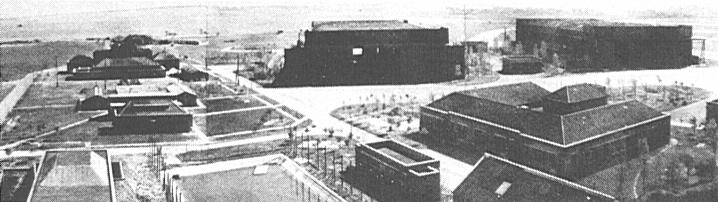
08-04

Figure 8.4 Harwell Aerodrome.

« Guinea Pig Club
Harwell in Wartime »

Harwell is a village in south Oxfordshire, England, although until 1974 it was a Berkshire village. Harwell was first mentioned in 985, before the Doomsday Book.
This website presents the full text of the book (ISBN 0 9510668 0 3 ) published in 1985 to celebrate the village millennium.
"Harwell ~ Village for a thousand years"

Additional information about Harwell Village (History Notes, photos and more) can be found at harwellvillage.uk

Website © 2005–2026 maintained and managed by David Marsh on behalf of Harwell Parish Council
Copyright © 1985–2026 in the text of the book is vested in Harwell Parish Council