Harwell: Village for a thousand years

  • Harwell Book
    • Introduction
      • Contents
    • Beginnings
      • The Beginnings of Harwell
      • The Charters
    • Middle Ages
      • Harwell Church
      • The Medieval Manors
      • Cruck Buildings
    • Tudors
      • The Tudor period
      • Berkshire Farmers and their Homes
      • The Harwell Mug
      • Harwell: The Family Name
      • Trade Tokens
      • In the Civil War
    • Charities
      • John Loder
      • Christopher Elderfield
      • Poor’s Orchard
      • William Wells
      • J. King
      • Frances Geering
      • Matthew Eaton
      • Robert Loder
      • Bag(g)’s Tree
      • An Old Harwell Recipe
    • 19th C
      • Enclosures
      • The Great Fire of Harwell
      • Fire at Didcot Station
      • Harwell and the Early Posts
    • People
      • The Manor of Bishop’s Harwell, or Lower Manor, after the Middle Ages.
      • Bob Lay, Bob Lay, Bob Lay
      • The Bosley Family
      • John Lay of Prince’s Manor 1815 – 1888
      • From a book sold for the Blewbury Village Organ Fund in 1874.
      • Thomas James Pryor
      • The Day Family
      • The Hitchman Family
      • Other Old Harwell Families
      • Pillar House, Harwell
      • A Country Doctor (Dr Richard Rice)
      • Kelly’s Directory reports on the Harwell of 1891
      • The School
      • A Pictorial Miscellany
    • 20th C
      • Stanley Day
        • The Turn of the Century
        • A Visit to Harwell
      • Tape Recordings
        • A Houseboy at Harwell
        • Eliza Hutchings
        • Harwell Bakeries
        • The Eggs
        • Old Neighbours
        • Fire at King’s Farm (c.1908)
        • Will It Light?
        • Miss Irene Clarke’s memories.
      • Poem by H.S. Baker
    • WWII
      • Guinea Pig Club
      • Eric Greenwood
      • Harwell in Wartime
      • School Life in Wartime
      • The Harwell Players
    • 1945 -1985
      • The Atomic Energy Research Establishment.
      • Harwell Parish Council
      • Water and Sewage
      • Nursing Service
      • School Life after the War
      • The Winterbrook Youth Club
      • The Public Houses
      • The Whit Monday Feast
      • Wild Flowers of Harwell
      • The Bee Orchid
      • Village Footpaths
      • St Matthew’s Church Today
      • Harwell Women’s Institute
      • Harwell Bowls Club
      • Harwell Football Club
    • Cherries
      • Robert Loder
      • Cherries (1965)
      • Gordon Bosley
      • John Masefield: The Cherries
    • Appendices
      • Appendix I the Harwell Charters
        • Introduction to The Harwell Charters
        • Charter No 1
        • Charter No 2
        • Charter No 3
        • Appendix I Charter References
      • Appendix II Buildings
      • Appendix III Glossary
      • Appendix IV Contributors
      • Appendix V References
« Berkshire Farmers and their...
Harwell: The Family Name »
You are here: Home / Tudors / The Harwell Mug

The Harwell Mug

(1739)

The place-name Harwell has two different interpretations but Harwell as a surname did not appear until the thirteenth century. As Harwell is an uncommon surname it was interesting to discover a potter named John Harwell whose work has become important in ceramic history. Although John Harwell has no known link with Harwell or the Harwell Americans who have been traced back to thirteenth century village families, more research may reveal one.

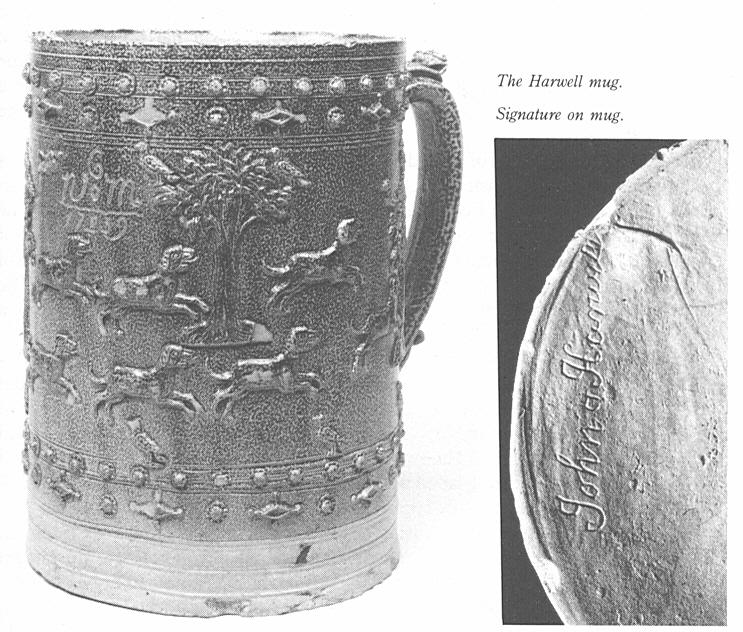
A mug known as the Harwell Mug is now on show in the renovated ceramic gallery of the Victoria and Albert Museum. Its existence as far as Harwellians are concerned, surprisingly, only came to light as a result of an interest in pottery and not as a result of researches into the surname Harwell. The Museum’s interest in the mug is that it is a documentary piece of Bristol stoneware and perhaps the finest piece of eighteenth century brown stoneware in existence.

Brown salt-glazed stoneware was in common use in the eighteenth century and many tankards were made. The freckled brown Harwell Mug is a large commemorative tankard 25cm in height; it gets its name from that of the potter John Harwell whose signature is incised on the base. The mug was made for the parliamentary election campaign in Bristol of Edward Southwell and bears the date 1739 and the slogan “Southwell for Ever”. It is the first time a political slogan is known to have appeared on a piece of English stoneware although examples of Bristol delftware with the same slogan also survive. The decoration around the mug is of a complete hare-hunting scene and the workmanship is excellent. The Harwell Mug and others only signed with J.H. have been an important link in identifying wares made at Bristol and which until a few years ago were thought to have been made at Fulham.

John Harwell worked at the Redcliffe Back Pottery of Thomas and William Frank in Bristol, where as an apprentice he made the mug. His latest dated piece was made in 1766, by which time he was involved with an earthenware retailing business, but it seems likely that his son carried on the tradition of making these giant mugs and decorating them in relief with trees, hunting figures, birds and a sun in the 1770s and 1780s. More details can be found in “English Brown Stoneware 1670 – 1900” by Adrian Oswald, R. J. C. Hildyard and R. G. Hughes. Dr R. Hildyard, Keeper of Ceramics at the Victoria and Albert Museum, provided the above information and the photograph of the mug.
03-06
Figure 3.6 The Harwell mug. [and signature]

Leave a Reply Cancel reply

Your email address will not be published. Required fields are marked *

This site uses Akismet to reduce spam. Learn how your comment data is processed.

« Berkshire Farmers and their...
Harwell: The Family Name »

Harwell is a village in south Oxfordshire, England, although until 1974 it was a Berkshire village. Harwell was first mentioned in 985, before the Doomsday Book.
This website presents the full text of the book (ISBN 0 9510668 0 3 ) published in 1985 to celebrate the village millennium.
"Harwell ~ Village for a thousand years"

Additional information about Harwell Village (History Notes, photos and more) can be found at harwellvillage.uk

Website © 2005–2026 maintained and managed by David Marsh on behalf of Harwell Parish Council
Copyright © 1985–2026 in the text of the book is vested in Harwell Parish Council